

Global Continuous Inkjet Inks Market to Reach USD 516.32 Million by 2036, Led by India & China | Sun Chemical Leads
Continuous Inkjet Inks Market Size
USA continuous inkjet inks market grows at 2.1% CAGR, driven by demand for secure beverage packaging, food labeling and durable, high-quality print information.
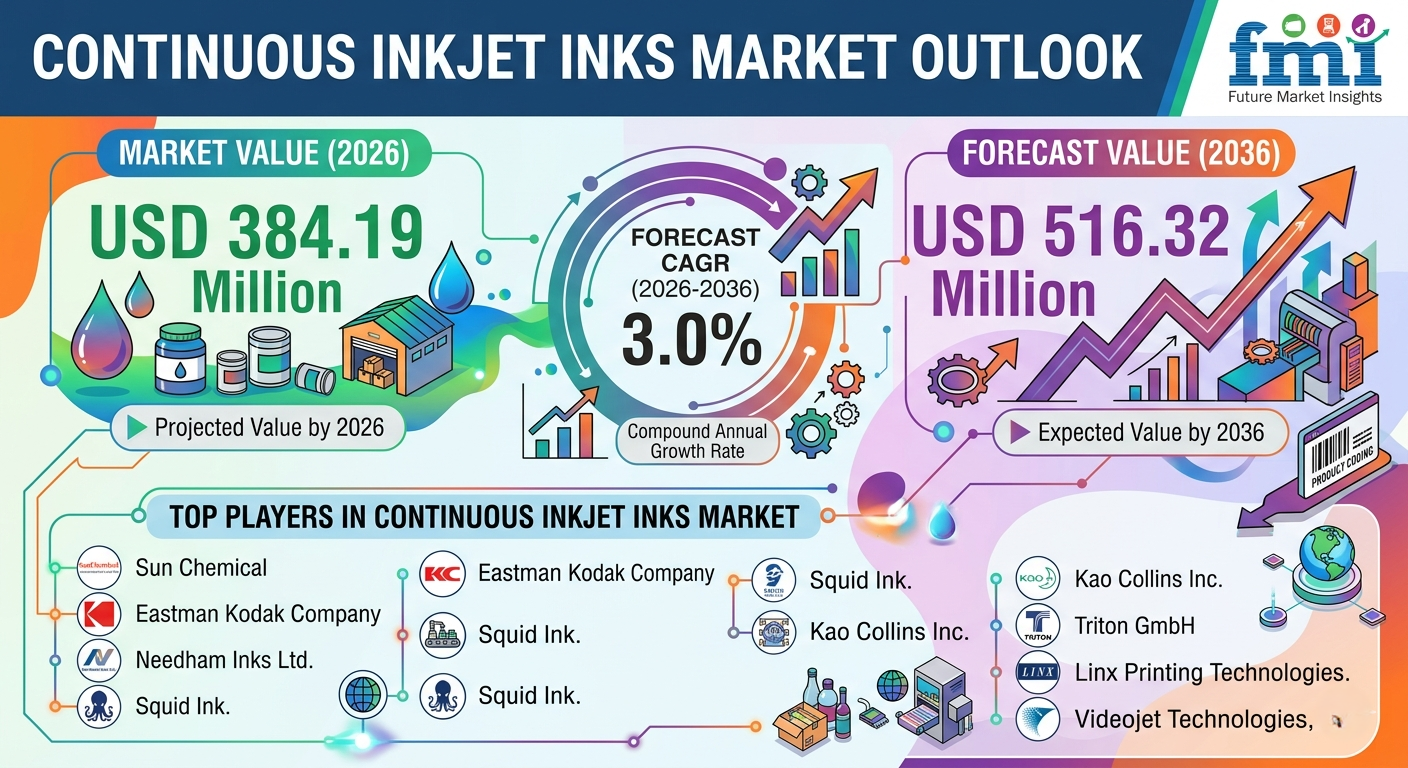
NEWARK, DE, UNITED STATES, April 1, 2026 /EINPresswire.com/ -- The global continuous inkjet inks ecosystem is entering a stability-driven growth phase, supported by industrial coding regulations, packaging traceability requirements, and expanding packaged goods manufacturing worldwide. Valued at USD 384.19 million in 2026, the market is projected to reach USD 516.32 million by 2036, growing at a CAGR of 3.0%. The market remains a consumables-driven industry where ink chemistry compatibility, adhesion performance, and regulatory compliance define long-term supplier competitiveness rather than price alone.
According to a strategic market outlook from Future Market Insights, continuous inkjet inks are becoming increasingly critical to global manufacturing operations, particularly in food, beverage, pharmaceutical, electronics, and industrial packaging sectors where coding, marking, and traceability are mandatory for regulatory compliance and supply chain visibility.
Discover Growth Opportunities in the Market – Get Your Sample Report Now
https://www.futuremarketinsights.com/reports/sample/rep-gb-11682
Industrial Coding Economy: The Hidden Backbone of Manufacturing Traceability
The continuous inkjet inks market operates within a regulatory-driven demand structure. Unlike discretionary printing markets, CIJ inks are used primarily for mandatory coding applications such as manufacturing dates, expiry dates, batch numbers, serialization codes, barcodes, and product identification markings.
Food safety regulations, pharmaceutical serialization laws, and product traceability mandates across global markets ensure that demand for industrial inkjet coding remains resilient even during economic slowdowns. This regulatory dependency effectively creates a demand floor for continuous inkjet inks across industries.
As packaged goods production volumes increase in emerging markets and manufacturing lines operate at higher speeds, ink performance requirements have become more demanding. Ink formulations must now perform reliably on mixed substrates including paper, plastic, glass, and metal while maintaining adhesion at high line speeds exceeding 300 meters per minute.
Industry analysts note that ink adhesion reliability and print durability are now more critical than cost per liter, as ink failure can lead to production downtime, compliance violations, and product recalls.
The Chemistry Shift: From Solvent-Based to Eco-Friendly Ink Systems
One of the most significant structural changes in the market is the gradual reformulation of ink chemistries. Environmental regulations targeting volatile organic compound (VOC) emissions are pushing manufacturers to transition away from traditional solvent-based inks toward water-based and UV curable ink technologies.
Water-based inks are emerging as the dominant segment, accounting for approximately 47.7% of the market share in 2026. These inks offer strong color quality, improved environmental compliance, and compatibility with a wide range of packaging materials.
At the same time, UV curable inks are gaining traction in pharmaceutical and electronics applications due to their fast drying capability, chemical resistance, and durability on non-porous surfaces such as plastic films, glass containers, blister packs, and electronic components.
Manufacturers are also increasingly developing eco-friendly inks derived from vegetable oil and bio-based raw materials to reduce environmental impact and comply with tightening environmental regulations in Europe and North America.
Segment Spotlight: Water-Based Inks and Paper Substrates Lead Market Demand
Within the continuous inkjet inks industry, demand is highly substrate-driven. Ink selection depends on the packaging material used across manufacturing industries.
Water-based inks continue to dominate due to their superior color vibrancy, adhesion performance, and environmental compliance advantages. These inks include both dye-based and pigment-based formulations, offering high optical density, color saturation, and print durability for branding and product identification applications.
On the substrate side, paper remains the leading material segment, holding approximately 50.1% of the market share. Paper and paperboard are widely used across packaged food, pharmaceuticals, and secondary packaging applications due to their cost-effectiveness and sustainability advantages compared to glass and metal packaging.
As sustainability initiatives increase globally, paper-based packaging materials are expected to remain the dominant substrate for continuous inkjet printing applications.
Regional Growth Engines: India and China Drive Market Expansion
While the continuous inkjet inks market is relatively mature in developed economies, the fastest growth is occurring in emerging manufacturing hubs where packaged goods production and pharmaceutical manufacturing are expanding rapidly.
India is projected to be the fastest-growing market with a CAGR of 5.1% through 2036, driven by the expansion of pharmaceutical manufacturing, food processing industries, and industrial packaging production. India’s growing startup ecosystem and manufacturing sector are also contributing to increased demand for cost-effective industrial printing solutions.
China follows closely with a projected CAGR of 4.5%, supported by its massive electronics manufacturing sector, packaging industry, and export-oriented production infrastructure.
Other countries show moderate growth trajectories including GCC countries at 2.6%, the United States at 2.1%, Brazil at 2.1%, the United Kingdom at 1.5%, and Germany at 1.2%, reflecting mature industrial printing markets with steady replacement demand cycles.
Dynamics of the Decade: Sustainability, Speed, and Compliance
Looking toward 2036, several structural trends are expected to define the competitive landscape of the continuous inkjet inks market.
• Eco-Friendly Ink Development: Manufacturers are increasingly investing in bio-based and low-VOC ink formulations to comply with environmental regulations and sustainability goals across packaging industries.
• High-Speed Printing Compatibility: Modern packaging lines operate at extremely high speeds, requiring inks that can dry quickly, adhere strongly, and resist abrasion, chemicals, and moisture.
• Multi-Substrate Printing: Manufacturers are moving toward universal ink platforms that can print on multiple substrates without requiring frequent ink changes, reducing downtime and inventory complexity.
• Traceability and Serialization Growth: Pharmaceutical serialization laws and food traceability regulations are increasing the volume of printed information required on packaging, boosting ink consumption per unit produced.
Competitive Landscape: Fragmented Market with Strong Tier-1 Players
The continuous inkjet inks market is characterized by a fragmented vendor landscape consisting of global ink manufacturers, regional ink suppliers, and niche formulation specialists. Market competition is driven by ink performance reliability, regulatory compliance certifications, and substrate compatibility rather than pricing alone.
Tier-1 companies hold significant market share due to their global distribution networks, advanced ink chemistry research capabilities, and long-term supply contracts with large packaging manufacturers and FMCG companies.
Key companies operating in the continuous inkjet inks market include Sun Chemical, Eastman Kodak Company, Needham Inks Ltd., Squid Ink, Kao Collins Inc., Triton GmbH, Linx Printing Technologies, and Videojet Technologies, Inc..
Many of these companies are investing in new ink formulations, acquisitions, and product launches to expand their market presence and strengthen their industrial printing portfolios.
Industry Outlook: Stable Growth with Regulatory-Driven Demand
The continuous inkjet inks market is expected to remain a stable, regulation-driven consumables market over the next decade. Unlike capital equipment markets, CIJ inks benefit from recurring demand as consumable products used across manufacturing lines globally.
The market’s growth will be supported by expanding packaged food production, pharmaceutical manufacturing growth, electronics production, and increasing regulatory requirements for product traceability and labeling.
As packaging materials evolve and sustainability regulations tighten, ink manufacturers that invest in eco-friendly formulations, high-speed printing compatibility, and multi-substrate adhesion technologies are expected to gain competitive advantage in the global continuous inkjet inks market through 2036.
Why FMI: https://www.futuremarketinsights.com/why-fmi
Explore More Research Reports by FMI
Aerosol Valves Market - https://www.futuremarketinsights.com/reports/aerosol-valves-market
Fruit Juice Packaging Market - https://www.futuremarketinsights.com/reports/fruit-juice-packaging-market
Design-for-Recycling Packaging Market - https://www.futuremarketinsights.com/reports/design-for-recycling-packaging-market
Holy Books and Scriptures Packaging Market - https://www.futuremarketinsights.com/reports/holy-books-and-scriptures-packaging-market
Instructional Packaging for Toddler Toys Market - https://www.futuremarketinsights.com/reports/instructional-packaging-for-toddler-toys-market
About Future Market Insights (FMI)
Future Market Insights, Inc. (FMI) is an ESOMAR-certified, ISO 9001:2015 market research and consulting organization, trusted by Fortune 500 clients and global enterprises. With operations in the U.S., UK, India, and Dubai, FMI provides data-backed insights and strategic intelligence across 30+ industries and 1200 markets worldwide.
Sudip Saha
Future Market Insights Inc.
+1 347-918-3531
email us here
Legal Disclaimer:
EIN Presswire provides this news content "as is" without warranty of any kind. We do not accept any responsibility or liability for the accuracy, content, images, videos, licenses, completeness, legality, or reliability of the information contained in this article. If you have any complaints or copyright issues related to this article, kindly contact the author above.
